What Symbols Do You See?
August 17th, 2010Life is art. Symbols are all around us. It’s fun to analyze objects and have them be metaphors to help us understand this crazy, wonderful world.
I used to hang out with a psychic man. When the King of Swords card would come up in a tarot reading, he liked to say, “The finest metals are always tempered with tremendous heat”. Meaning, the strongest, finest people have to experience a lot of “heat” in their lives to produce the character that allows them to excel.
I like to use crystals as metaphors for people, too. They also are often formed under tremendous heat and pressure. While forming, the “law of attraction” is also at play. The crystal is formed from solute molecules that attract each other and join together. Most of the time, when there are just a few of the solute molecules, they break apart and cannot form into a crystal. But when there are enough, and they have achieved their own critical mass, they manifest into treasures we know and love as crystals. With molecules attracting each other, coming together to form beautiful natural objects through some kind of adversity- either heat and pressure or evaporation, some change was involved. As difficult as it sometimes seems to experience adverse change in our personal lives, it helps if you can remember that even adverse change can be very good.
Another interesting thing about crystals is that they vibrate at certain rates when an electrical current is passed through them. Using the metaphor of being a sword, you can cut through red tape and be decisive. With crystals, you can be pretty, and vibrate at such a rate you can be used to facilitate timing (such as the movement in quartz watches) and process information (such as silicon wafers in computer chips). And when a beautiful, vibrating entity has attracted enough “like minds” or solute molecules achieving critical mass, a real gem has been added to our lives.
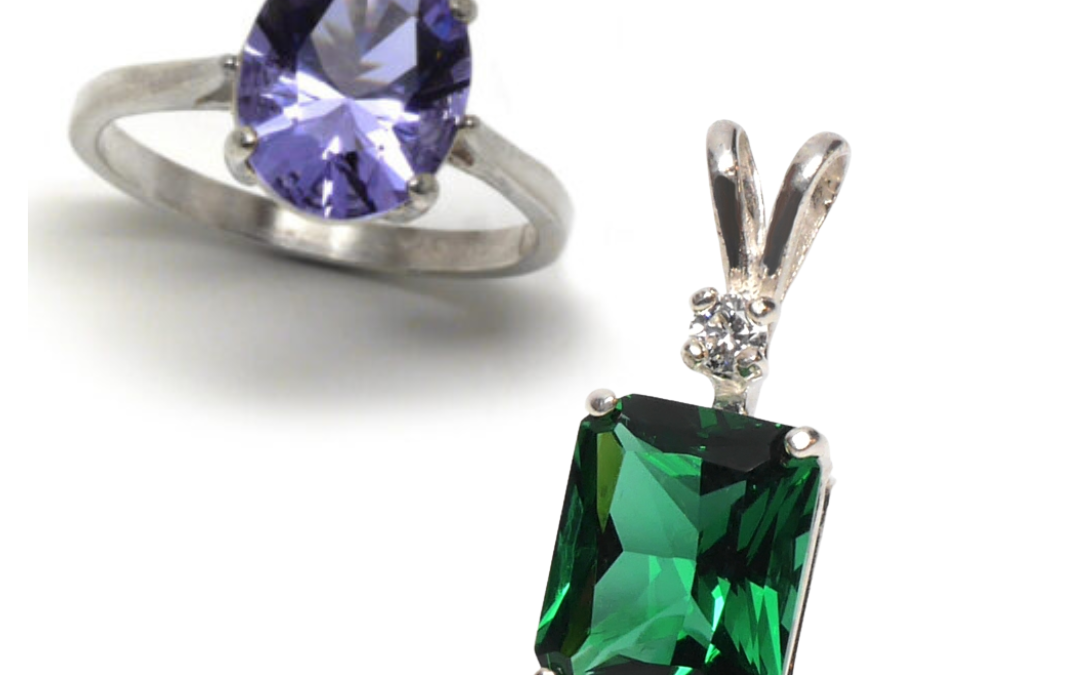
Crystals display facets reflecting the underlying symmetry of the crystal structure. Beside the metaphor of crystals and people, the many “facets” of life are like fine gems to me. This can be applied to all sorts of things: groups of people (social, religious, political, economic, sociological, psychological, etc.), each significant personal experience, nature, progress, mediums of art and expression, the life cycle, etc.. They all reflect a different, beautiful light as in the facets of a crystal or the cuts in a faceted gemstone.
Beads are great symbols, too. I like to think of my most significant personal experiences as the beads that make up my “life necklace”. I’m sure you’ve all heard, “Life is a tapestry”. Weavers and other fiber artists can probably identify with that one. What symbols resonate with you in your life?
Question: How do crystals form? —Dave
Answer:
Crystals usually form from molten rock as the molten
rock gradually cools. If the molten rock
cools very rapidly, then either small crystals
form or no crystals form. An example of this
is when lava is ejected from a volcano. If
molten rock cools slowly, then large crystals
can form. This happens usually when the molten
material is very deep in the Earth. Examples
of these types of crystals are diamonds, emeralds,
rubies, etc.
Crystals can also form when water evaporates.
For example, salt crystals (sodium chloride) form
when salt water evaporates.
The smooth faces of crystals are caused by
a regular internal arrangement of atoms.
-Grant
Each different crystal vibrates at a specific frequency when an electric current is passed through it. The original radios were created using vibrating crystals to create the frequency to transmit signals. As radio technology improved, radio transmitters had several different crystals to allow transmission on different frequencies. Modern radios have large number of different frequencies used by radio stations.
Vibrating crystals can be used for time keeping. A quartz clock uses the vibration of a quartz crystal to measure time. When the crystal has an electric current passed through it, the crystal will vibrate at 60 hertz (60 times per second).